
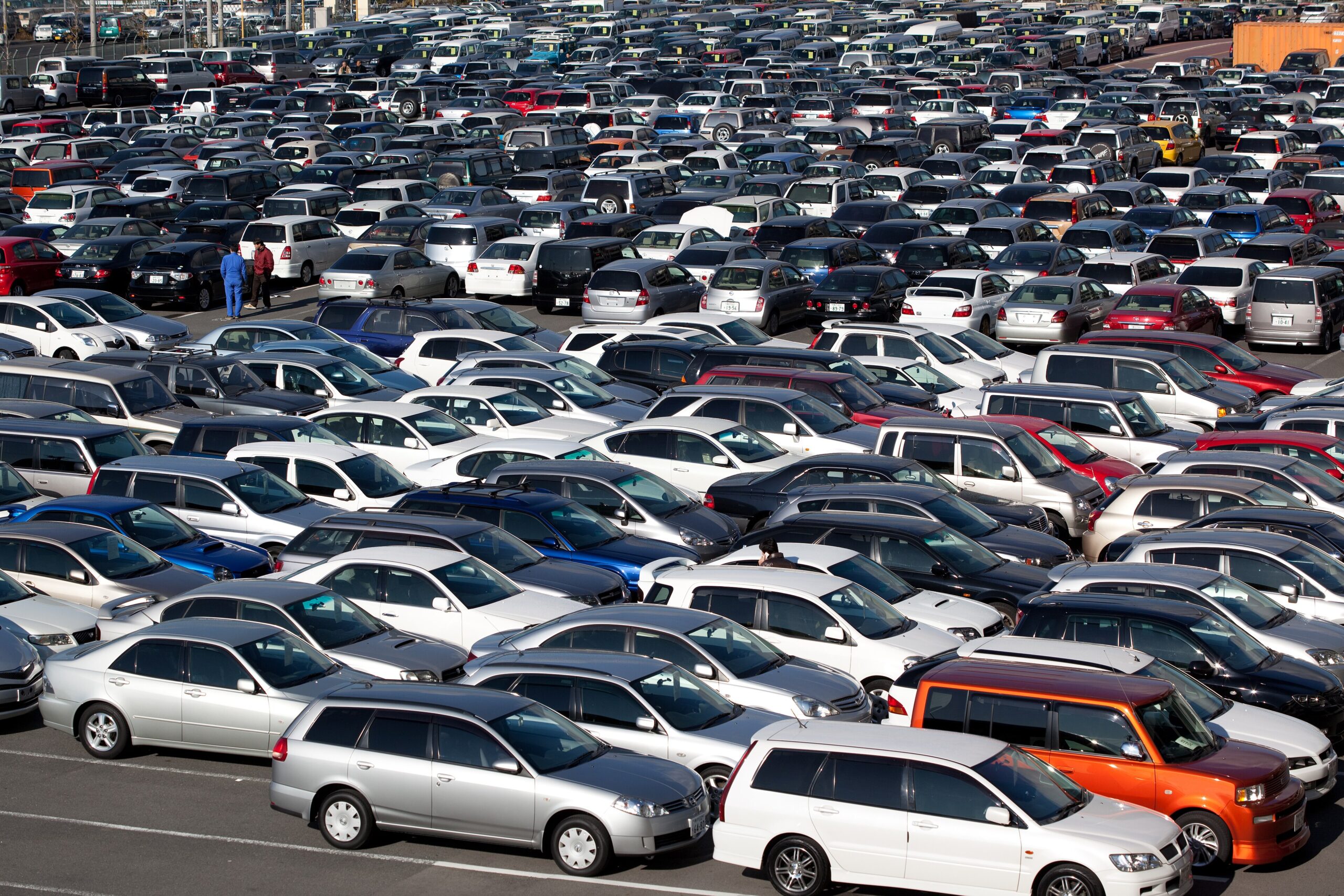
Japan has over 120 active car auction venues. Every week, roughly 140,000 vehicles pass through these auction halls across the country. This is the supply chain that feeds the entire UK JDM import market, and most UK buyers never learn how it works.
Your importer bids at these auctions on your behalf. The car you end up driving started its journey to the UK in one of these halls. Understanding the auction landscape does not mean you need to bid yourself (you cannot; membership requires a Japanese dealer licence), but it does mean you can have an informed conversation with your importer about where they source, why it matters, and what the differences between auction houses mean for the car you receive.
This article covers every auction network a UK buyer is likely to encounter, from the largest (USS, with 19 venues and roughly 40% of the entire market) to the specialist and regional houses that handle niche inventory.
How Japanese car auctions work
Before the individual houses, a quick overview of the system itself.
Japanese car auctions are B2B marketplaces. They exist for licensed Japanese used car dealers to buy and sell trade-in stock. General consumers cannot participate. Overseas buyers access the system through a licensed Japanese auction agent or a UK-based importer who works with one.
The process:
- A Japanese dealer consigns a vehicle to an auction house.
- The auction house’s inspector examines the car and produces an auction sheet: a detailed condition report with an overall grade, interior grade, exterior grade, condition diagram, and inspector notes.
- The car enters the auction lane (physically at the venue, or streamed online). Bidding is live and fast, typically lasting 30-90 seconds per car.
- If the bidding reaches the seller’s reserve price, the car is sold. If not, it ‘passes in’ unsold and may be relisted at a future sale.
- The winning bidder (your importer’s agent) arranges collection and inland transport to the export port.
Auctions run six days a week across the country, Monday through Saturday. Each venue holds one sale per week on its assigned day. The three largest national networks (USS, TAA, and CAA) account for the bulk of weekly volume, but dozens of smaller networks and independent houses run alongside them.
USS (Used Car System Solutions)
The largest. The benchmark. The one every importer uses.
USS is Japan’s largest auction operator, with 19 venues nationwide and approximately 41% market share of the entire Japanese auto auction industry (per USS’s own FY2024 reporting). USS Tokyo alone can handle over 18,000 vehicles in a single sale day, with cars running through up to 10 simultaneous auction lanes.
Key facts
- Venues: 19 locations covering every region from Hokkaido (USS Sapporo) to Kyushu (USS Kyushu, Kagoshima site).
- Major locations: USS Tokyo (Thursday, the single largest auction in Japan), USS Nagoya, USS Yokohama, USS Osaka, USS Kobe.
- Weekly volume: The highest of any network. USS Tokyo alone processes 10,000-18,000 vehicles per sale.
- Auction days: Vary by venue. USS Tokyo runs on Thursdays; other venues are spread across the week.
- Online bidding: Available through USS’s proprietary system. Remote bidding is standard for agents who are not physically present at the venue.
Why USS matters for UK buyers
USS offers the widest variety of stock across all makes, models, and price points. If the car you want exists at auction in Japan, the highest probability of finding it is at a USS sale.
USS auction sheets are generally considered the most detailed and consistent in the industry. USS pioneered electronic grading and remote bidding, and their inspection standards are the benchmark against which other houses are measured.
USS also commonly pairs R grades (repaired accident history) with numeric condition grades (R-4, R-3.5), which separates the accident history from the current cosmetic condition. This is more useful than a standalone R grade because it tells you what the car looks like now, independent of what happened to it in the past.
USS-R
USS also operates USS-R sites (Tokyo and Nagoya) that specialise in reusable vehicles: cars that are older, higher-mileage, or lower-grade than the main USS sales typically handle. USS-R inventory is aimed at the export market and domestic budget segment. UK buyers rarely source from USS-R unless looking for very specific older or project vehicles.
TAA (Toyota Auto Auction)
The Toyota Group’s auction arm. Conservative grading, excellent stock quality.
TAA was the first auto auction in Japan, launched in 1967 with three venues in Tokyo (Kanto), Nagoya (Chubu), and Osaka (Kinki). It is operated by the Toyota Group and has expanded to 10-11 venues across the country, including Tohoku, Kyushu, Yokohama, Hokkaido, Hiroshima, Shikoku, and Minami-Kyushu.
Key facts
- Venues: 10-11 locations nationwide.
- Major locations: TAA Kanto (Thursday, the flagship), TAA Chubu (Thursday), TAA Kinki.
- Auction days: Primarily Thursdays, with some regional variation.
- Online bidding: Through the TC-webΣ system. Direct access is restricted to licensed Japanese dealers, but UK buyers reach TC-webΣ stock indirectly through their importer’s Japanese agent.
- Speciality: Toyota, Lexus, and Daihatsu stock is disproportionately represented because TAA is where Toyota dealers sell their trade-ins.
Why TAA matters for UK buyers
TAA is the best source for Toyota and Lexus imports because the inventory is fed directly by Toyota’s dealer network. If you are importing an Alphard, Vellfire, Noah, Crown, or any Toyota model, TAA will have the widest selection of that specific make.
TAA has a reputation for slightly more conservative grading than USS. A TAA grade 4.5 is arguably equivalent to a USS grade 4.5-to-5 in terms of actual condition. This is an advantage for the buyer: when your importer tells you a car is grade 4.5 at TAA, you can be confident it is genuinely in good condition.
TAA also provides higher-resolution images than the industry average (640×480 vs the more common 300×225), which makes remote assessment easier.
HAA (Honda Auto Auction)
Honda’s dedicated auction network. Specialist stock, high closing ratios.
HAA (Honda Auto Auction) is Honda’s equivalent of TAA: a manufacturer-backed auction network where Honda dealers sell their trade-in stock. HAA operates six venues across Japan: Tokyo, Kansai (Osaka), Nagoya, Sendai, Kyushu, and Hokkaido. (A separate, unrelated Osaka auction called Hanaten 8710 is easy to confuse with HAA because of the abbreviation — different company, different stock, no Honda affiliation.)
Key facts
- Venues: 6 locations.
- Major locations: HAA Tokyo (Monday), HAA Kansai/Osaka (Monday).
- Auction days: Primarily Mondays.
- Closing ratio: Well above the industry average. The manufacturer-backed trade-in supply moves quickly, and most cars sell on first listing.
- Speciality: Honda and Acura vehicles, including JDM-only models (Odyssey, Freed, Step WGN, Fit/Jazz, N-Box, S660).
Why HAA matters for UK buyers
If you are importing a Honda, HAA is the primary source. The stock is fed by Honda’s dealer network, so the selection of Honda models is deeper than at USS or TAA.
HAA grading is consistent and reliable, similar in conservatism to TAA. Honda’s inspection standards are thorough, and the auction sheets are detailed.
The high closing ratio means competition is real: popular Honda models (S2000, Civic Type R, Integra Type R, Odyssey Absolute) attract aggressive bidding at HAA. Your importer needs to be prepared to act quickly and decisively.
JU (Japan Used Car Dealers Union)
The regional network. Huge reach, variable consistency.
JU is not a single auction house but a network of semi-independent regional auctions operating under the Japan Used Car Dealers’ Association umbrella. JU venues exist in almost every prefecture in Japan, making it one of the largest networks by number of locations.
Key facts
- Venues: 30+ locations across nearly every prefecture.
- Major locations: JU Tokyo (Monday), JU Kanagawa, JU Saitama, JU Nagano, JU Shizuoka.
- Auction days: Spread across the week; varies by prefecture. JU Tokyo runs on Mondays.
- Volume per venue: Lower than USS or TAA. Individual JU venues typically process 500-2,000 vehicles per sale.
- Speciality: Broad, all-makes inventory. JU venues often carry local dealer trade-ins that do not appear at the larger national houses.
Why JU matters for UK buyers
JU’s strength is its regional reach. Cars that are consigned to a local JU venue in a rural prefecture may never appear at a USS or TAA sale. This makes JU a valuable secondary source for importers looking for specific vehicles that are not appearing at the major houses.
The trade-off is consistency. Because JU venues are semi-independent, grading standards vary by location. A JU grade 4 in one prefecture may be equivalent to a grade 3.5 at USS. Your importer should know the specific JU venues and their tendencies; an experienced importer will adjust their assessment based on which JU location the car is listed at.
JU also occasionally surfaces hidden gems: low-mileage, single-owner cars from rural areas where the original owner simply traded in at their local dealer. These cars can represent exceptional value because they attract less competition than the same car at USS Tokyo.
CAA (Central Auto Auction / Chubu Auto Auction)
The independent mid-tier. Solid quality, lower volume.
CAA is an independent national auction operator (not manufacturer-backed) with four venues covering Tohoku, Kanto, Chubu, and Gifu. It is smaller than USS or TAA but is respected for consistent quality and straightforward auction sheets.
Key facts
- Venues: 4 locations (CAA Tokyo, CAA Chubu, CAA Gifu, CAA Tohoku).
- Auction days: Tuesdays (Tokyo, Gifu, Tohoku) and Wednesdays (Chubu).
- Weekly volume: CAA Chubu is the flagship by weekly volume. Across the four venues, CAA exhibits roughly 450,000 units annually (CAA’s own reporting); CAA Chubu and CAA Tokyo handle the largest share per sale.
- Online bidding: Through the TC-webΣ system (shared with TAA).
Why CAA matters for UK buyers
CAA is a solid supplementary source. Grading is generally consistent with USS, and the inspection quality is good. CAA venues tend to carry strong independent-dealer trade-in stock that sits alongside the manufacturer-backed inventory at TAA and HAA.
CAA Chubu (Wednesday) is particularly useful because it runs on a different day from USS Tokyo and TAA Kanto (both Thursday), giving importers an additional auction day to source vehicles without competing against the Thursday rush.
Nissan Auto Auction (NAA)
Nissan’s dealer network auction.
NAA operates Nissan’s dealer trade-in auctions across several venues, with NAA Osaka, NAA Tokyo, and NAA Fukuoka among the most active. NAA works similarly to TAA and HAA: Nissan dealers consign their trade-ins, and the auction house inspects and sells them.
Key facts
- Major locations: NAA Osaka, NAA Tokyo, NAA Fukuoka. Auction days vary by venue and shift between Monday and midweek; ask your importer to confirm the schedule for the car you’re targeting.
- Speciality: Nissan, Infiniti, and Datsun stock.
- Volume: Lower than TAA. NAA is a secondary source rather than a primary one.
Why NAA matters for UK buyers
If you are importing a Nissan-specific model (Elgrand, Serena, Skyline, Silvia, Note e-Power), NAA is worth including in the search. However, Nissan vehicles appear frequently at USS and JU sales as well, so NAA is supplementary rather than essential.
AUCNET
The online-only pioneer. No physical venue.
AUCNET was one of the first Japanese auction houses to operate entirely online, using satellite-linked bidding without a physical auction floor (the satellite system launched in 1985). Car auctions run weekly on Mondays.
Key facts
- Physical venues: None. Entirely online/satellite.
- Auction days: Monday (car auctions; AUCNET also runs separate brand/luxury-goods auctions on other days).
- Speciality: All makes. AUCNET’s online-only model means cars are inspected and photographed at the consigning dealer’s premises rather than at a central auction hall.
Why AUCNET matters for UK buyers
AUCNET expands the pool of available vehicles beyond those that have been physically transported to an auction hall. Some dealers consign to AUCNET because it is more convenient than transporting the car to a USS or TAA venue. This means AUCNET occasionally surfaces stock that does not appear elsewhere.
The trade-off is that the inspection is conducted at the dealer’s premises rather than by a central auction house inspector, which can introduce slightly more variability in grading accuracy.
ARAI
The specialist for older, enthusiast, and classic vehicles.
ARAI operates five established venues — Sendai, Oyama (Tochigi Prefecture), Bayside (Kanagawa, Yokohama area), Kansai, and Fukuoka — plus a recently opened Nagoya site. ARAI has a reputation for carrying a higher proportion of enthusiast and classic vehicles than the mainstream houses.
Key facts
- Major locations: ARAI Oyama (the flagship), ARAI Bayside, ARAI Sendai, ARAI Kansai, ARAI Fukuoka, and the newer ARAI Nagoya.
- Speciality: Classic cars, enthusiast vehicles, higher-end stock. ARAI is where you are more likely to find a clean AE86, a low-mileage Supra, or a well-preserved Hakosuka than at USS.
Why ARAI matters for UK buyers
If you are looking for a specific enthusiast or classic JDM car, ARAI is a valuable source. The stock profile skews older and more collectible than USS or TAA. Prices tend to be higher for desirable models, but condition is often excellent because the cars are consigned by specialist dealers and collectors.
Bayauc
Western Japan’s largest independent.
Bayauc is based in Osaka (Suminoe ward) and has been operating since 1978 (originally as the Osaka Nanko Used Car Cooperative), making it one of the oldest auction venues in Japan. It is an independent house (not manufacturer-backed) with a strong regional presence in the Kansai area.
Key facts
- Location: Osaka.
- Auction day: Midweek (typically Wednesday). Confirm with your importer ahead of any bid.
- Speciality: Broad, all-makes stock with a Kansai regional focus.
Why Bayauc matters for UK buyers
Bayauc is a regional house, so it is a supplementary source rather than a primary one. Its usefulness depends on your importer’s network: an importer who sources from Bayauc in addition to USS and TAA is demonstrating breadth of coverage, which increases the probability of finding the specific car you want.
Other houses worth knowing
Beyond the major networks, several smaller or specialist houses appear in the import chain:
- LAA Kansai (Thursday, Kinki region): A mid-sized independent house with solid stock quality.
- ZIP (Osaka Thursday, Tokyo Tuesday): An independent house with venues in both Kanto and Kansai.
- GAO! / Gulliver Auction (Monday): Run by IDOM Inc. (formerly Gulliver Inc., rebranded in 2016), one of Japan’s largest used car retail chains. Approximately 6,000 vehicles weekly, with both auction and fixed-price options.
- HERO (Wednesday, online): Internet-only auction for registered members.
- TTA / Toyota Tsusho Auction (online via Carused.jp): A newer online auction platform launched through Toyota Tsusho Corporation, offering authorised online bidding to overseas buyers through the Carused.jp platform.
Which auction houses should your importer cover?
A competent UK importer should be sourcing from at minimum USS, TAA, and one or two of the secondary networks (HAA, JU, CAA). An importer who only sources from USS is leaving stock on the table. An importer who sources from USS, TAA, HAA, JU, CAA, and a handful of regional houses is maximising the probability of finding the right car at the right price.
Questions to ask your importer:
- Which auction houses do you have access to? The answer should include at least USS and TAA. Ideally also HAA, JU, and CAA.
- How many venues do you monitor? A good importer monitors 40-80+ venues. The more venues, the wider the search.
- Do you source from manufacturer-specific auctions? If you want a Toyota, the importer should be checking TAA. If you want a Honda, they should be checking HAA.
- Can you source from regional JU venues? JU’s regional network surfaces cars that do not appear at the major national houses.
- Do you adjust your assessment based on the auction house? A grade 4.5 at TAA and a grade 4.5 at a small JU venue are not the same thing. Your importer should know this and factor it into their advice.
The auction calendar at a glance
| Day | Major auctions |
|---|---|
| Monday | HAA (all venues), JU Tokyo, AUCNET, GAO!, NAA Osaka |
| Tuesday | CAA (Tokyo, Gifu, Tohoku), JU (multiple prefectures), NAA Fukuoka, ZIP Tokyo |
| Wednesday | USS Sapporo, CAA Chubu, HERO, Bayauc, USS (selected venues) |
| Thursday | USS Tokyo (the big one), TAA Kanto, TAA Chubu, TAA Hokkaido, ARAI Oyama, LAA Kansai, ZIP Osaka |
| Friday | USS (selected venues), JU Sapporo, regional houses |
| Saturday | USS (selected venues), JU (selected prefectures) |
Thursday is the busiest day in Japanese auto auctions. USS Tokyo and TAA Kanto running on the same day means the highest volume and the widest selection, but also the most competition.
How this connects to the grading system
Every auction house covered in this article uses a grading system to assess vehicle condition. The core numeric scale (S through 1) and the special codes (R, RA, A, *) are broadly consistent across houses, but there are meaningful differences in how strictly each house applies the grades and which additional codes they use.
Our companion article on auction grades covers every grade and code in detail, including which houses grade more conservatively, how USS pairs R grades with numeric condition scores, and why a grade 4.5 at TAA is not the same as a grade 4.5 at a small JU regional venue.