
The Toyota Noah, Voxy and Esquire are the same car wearing three different jackets. Together they are the best-selling Japanese family minivan of the last twenty-five years — and one of the most rewarding imports a UK family can buy. This guide covers all four generations: R60, R70, R80 and R90. What changed, what to look for, and which year and trim to actually buy in 2026.
Why this car, why this guide
The Noah is the family-sized JDM MPV that British buyers fundamentally do not know exists. Toyota never officially sold it in the UK — the closest equivalent on UK forecourts was the much smaller Verso, which is a different proposition entirely. Yet the Noah is built to a domestic-market Toyota specification that has never had to compromise for export: sliding doors on both sides from the R70 onwards, seven- or eight-seater capacity in a vehicle smaller than a Ford Galaxy, hybrid options from 2014, captain’s chair second rows, and the kind of fit and finish that quietly humiliates almost everything in its UK price bracket.
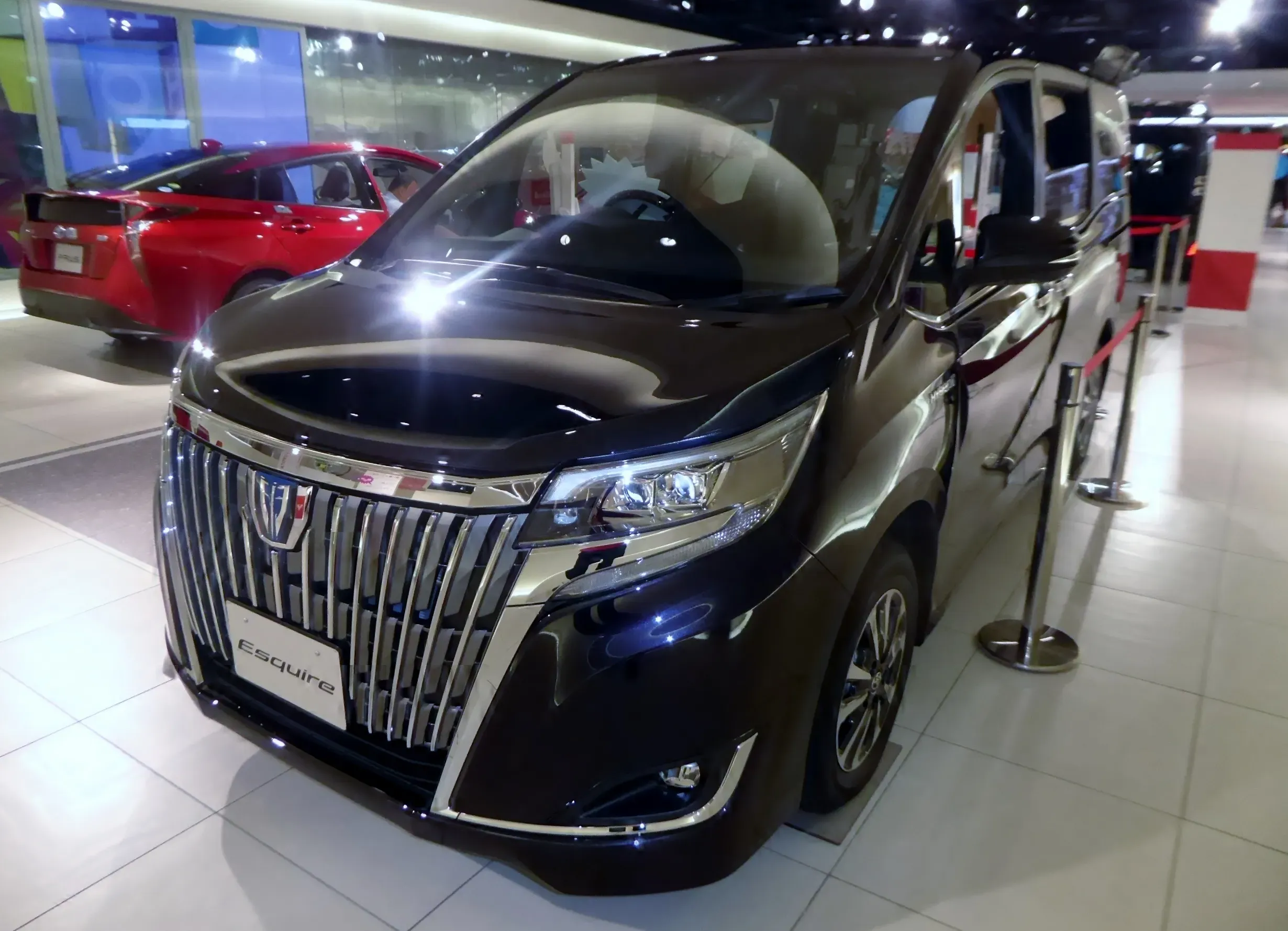
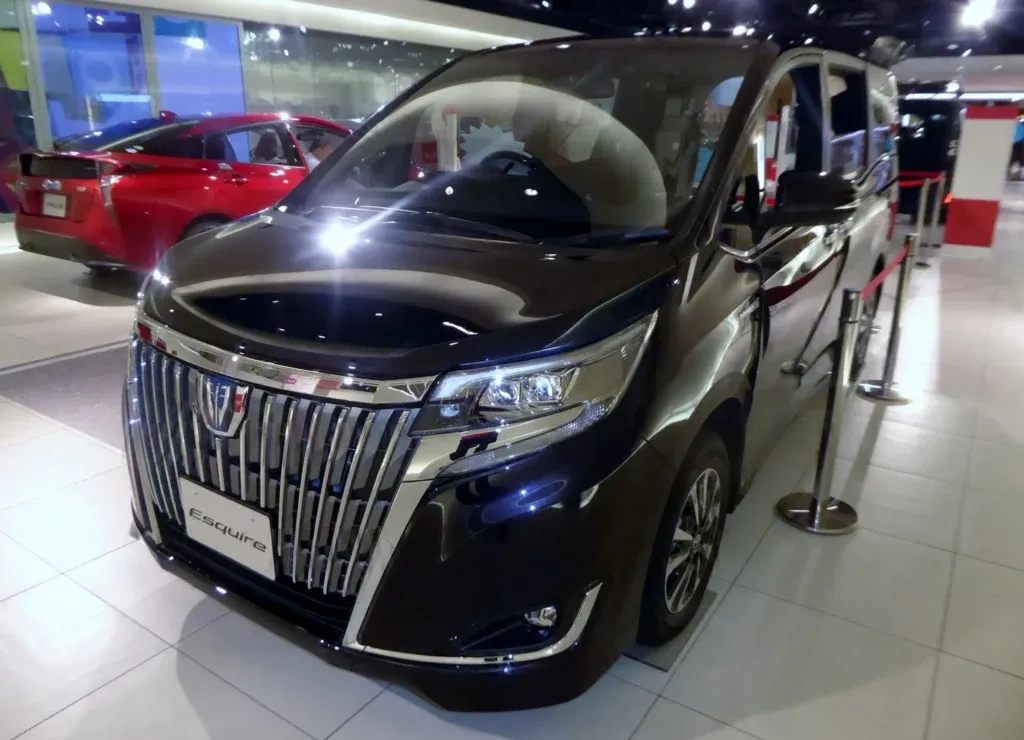
For the purposes of this guide, when we say “Noah” we generally mean the whole family. The Noah itself is the conservative-looking version. The Voxy is the sportier-styled twin sold alongside it from day one. The Esquire is the more luxurious third twin that appeared only on the R80 (2014-2021). All three are mechanically identical within a given generation — the differences are grille, headlight design, trim level, and interior finish.
Generation by generation
First generation — R60 (2001-2007)
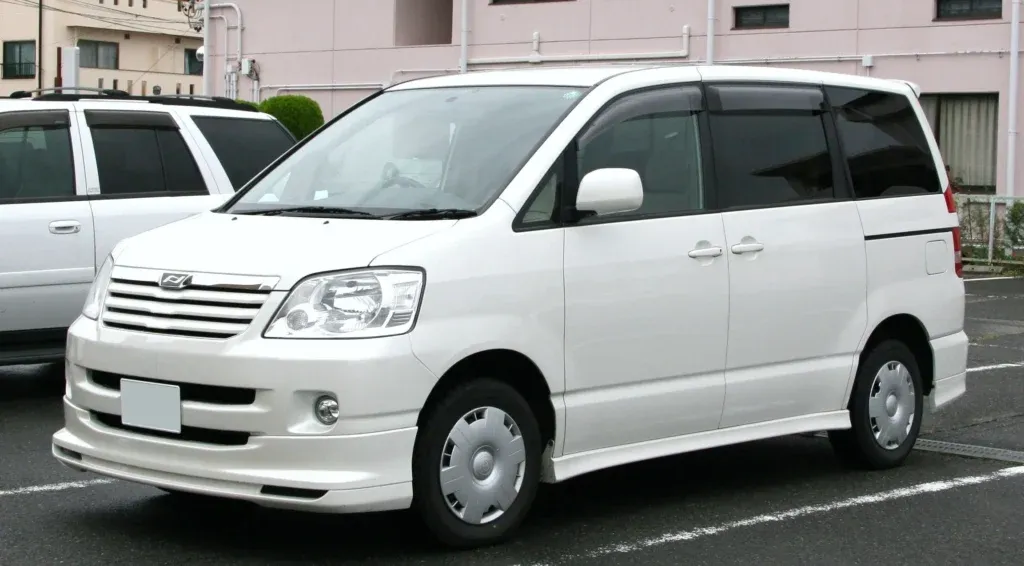
The R60 was the car that turned the Noah from a TownAce-derived workhorse into a proper passenger MPV. Toyota replaced the previous LiteAce Noah with a clean-sheet design on a front-wheel-drive platform shared with the Ipsum and Wish, and launched it in November 2001. The Voxy arrived as the sporty twin at the same time.
Visually the R60 is the most dated of the four generations — single-piece headlamps, conventional proportions, none of the boxy aggression that would later become a Noah signature. Sliding doors were available on the passenger side from launch but a single hinged door on the driver’s side, a layout that disappeared with the R70.
Engines were straightforward 2.0-litre petrol fours (1AZ-FSE direct-injection and 3S-FE port-injection) paired with a four-speed automatic, with both front-wheel drive and four-wheel drive offered. Seven and eight-seat configurations were available from launch.
For a UK buyer in 2026, the R60 is mostly a budget choice. Direct-injection engines on the 1AZ-FSE are known for carbon build-up on the intake valves — a known JDM-tax service item, but solvable. Rust is the bigger concern after twenty-plus years of Japanese coastal salt and snow.
Second generation — R70 (2007-2014)
The R70 is, for our money, the sweet spot of the Noah lineage. But then again, I would say that – I own one.
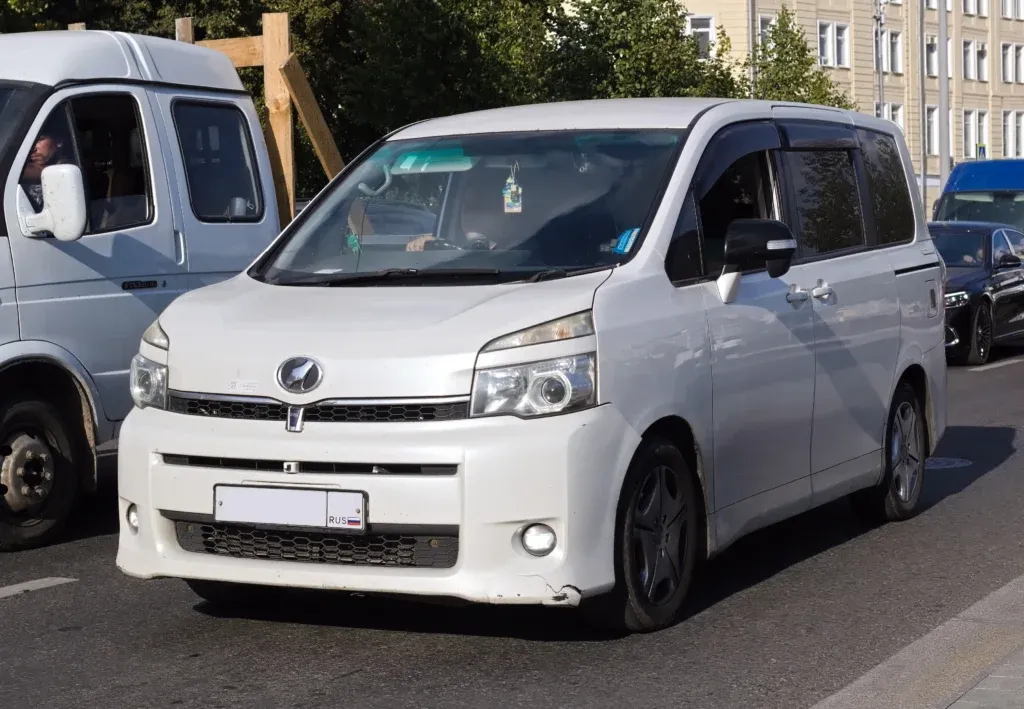
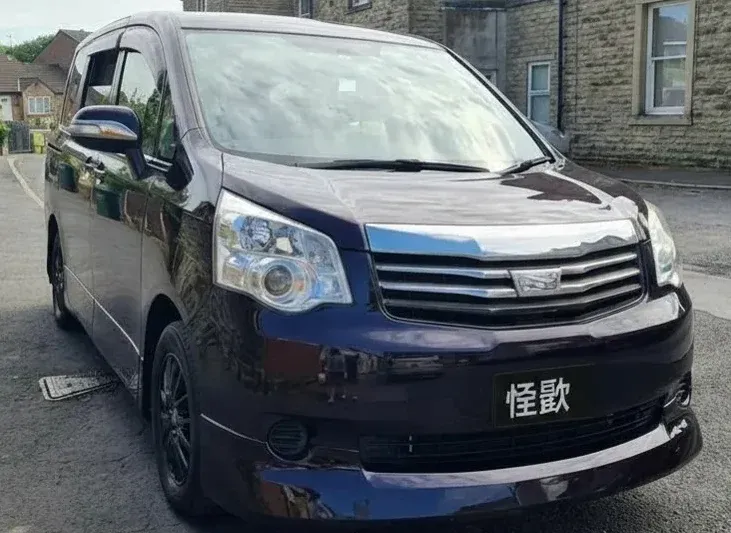
Toyota redesigned the car onto a new MC platform (shared with the Avensis and Corolla of the era), gave it sliding doors on both sides, switched the engine to the much-improved 3ZR-FE Valvematic 2.0-litre petrol unit, and introduced the modern split-personality styling that has defined the Noah/Voxy split ever since: the Noah keeps a conservative single-bar grille and unified headlights; the Voxy gets a split-type headlight design and a clear taillight lens, and visibly borrows styling cues that would later appear on the larger Vellfire.
The gearbox switched to a CVT (continuously variable transmission), which on the Toyota K310 series is one of the more durable units of its type — a strong point on the R70 if the service history is clean. Four-wheel drive remained available. The R70 was offered as a seven-seater with captain’s chairs in the second row or an eight-seater with a bench, both with a folding third row.
Kit on a mid-grade R70 typically includes: twin power-sliding doors, automatic air-conditioning with rear vents, alloy wheels, keyless entry and start, factory parking sensors, an integrated touchscreen head unit (Japanese-language by default — worth budgeting for an English firmware swap or aftermarket head unit on arrival in the UK), and on top trims a sunroof, ottoman second-row seats, and dual-zone climate.
Third generation — R80 (2014-2022)
The R80 launched in January 2014 and brought three significant changes. First, the Noah and Voxy gained a hybrid powertrain option — the 2ZR-FXE 1.8-litre with Hybrid Synergy Drive — making the R80 the first JDM 8-seat MPV available as a full hybrid. Second, Toyota added a third badge: the Esquire, a more luxurious variant with a different grille design, a more upmarket interior, and chrome-heavy detailing. Third, styling sharpened considerably — the Voxy especially, which adopted an aggressive multi-bar grille that gave it the nickname kuro Voxy (“black Voxy”) for the all-black ZS Kirameki edition.

Petrol R80s use the same 3ZR-FAE 2.0-litre as the late R70 with a CVT. Hybrids combine the 2ZR-FXE 1.8 petrol with electric motor for a combined output of around 134 hp — modest on paper but with vastly better fuel economy and the calm low-speed manners of any Toyota full hybrid. Real-world UK fuel economy on a hybrid R80 sits comfortably in the high-40s to low-50s mpg range, which for an eight-seater MPV is remarkable.
Top trims (Si, ZS, Gi Premium Package, Esquire Gi -pictured below) added LED headlights, larger touchscreens, panoramic mirror systems, Toyota Safety Sense suite items where fitted, leatherette upholstery, and on the Esquire a wood-effect dashboard inlay.
_front.jpg)
Fourth generation — R90 (2022-present)
The R90 launched in January 2022 on Toyota’s TNGA-C platform and represents the biggest leap in the model’s history. The Esquire was retired (sales were never strong enough to justify three twin badges), leaving the Noah and Voxy. Styling moved in two clearly distinct directions: the Noah went modernist and clean, the Voxy went deliberately aggressive with a vast piano-black grille that polarises opinion.
More significantly, the R90 is the first Noah to come with the current generation of Toyota Safety Sense, an electrically-powered tailgate option, USB-C charging throughout, and a hybrid system upgraded with a higher-output 2ZR-FXE that delivers genuinely brisk performance for the class. Non-hybrid grades were dropped at the April 2026 mid-cycle facelift, so any 2026 facelift R90 you find is a hybrid only.
The R90 is currently outside the UK’s ten-year tax-favourable import age window for most use cases, but the early 2022 cars are now reaching the four-year-old auction sweet spot in Japan and are starting to appear at UK importers at strong prices relative to UK-spec equivalents.
.jpg)
_front_view.jpg)
Generation comparison at a glance
| Generation | Years | Badges | Sliding doors | Engines | Gearbox | Hybrid? |
|---|---|---|---|---|---|---|
| R60 | 2001-2007 | Noah, Voxy | Passenger side only | 1AZ-FSE / 3S-FE 2.0L petrol | 4-speed auto | No |
| R70 | 2007-2014 | Noah, Voxy | Both sides | 3ZR-FE / 3ZR-FAE 2.0L petrol (Valvematic) | CVT | No |
| R80 | 2014-2022 | Noah, Voxy, Esquire | Both sides | 3ZR-FAE 2.0L petrol; 2ZR-FXE 1.8L hybrid | CVT / eCVT | Yes (from 2014) |
| R90 | 2022-present | Noah, Voxy (+ Suzuki Landy rebadge) | Both sides, optional power tailgate | M20A-FKS 2.0L petrol (pre-facelift); 2ZR-FXE 1.8L hybrid only post-2026 facelift | CVT / eCVT | Yes (hybrid-only after April 2026) |